I Didn't Hire a Team, I Cloned Myself
A field report from a year of AI-assisted delivery: how the workflow evolved, why the bottleneck moved downstream, and what I stopped doing.
What the talk was about
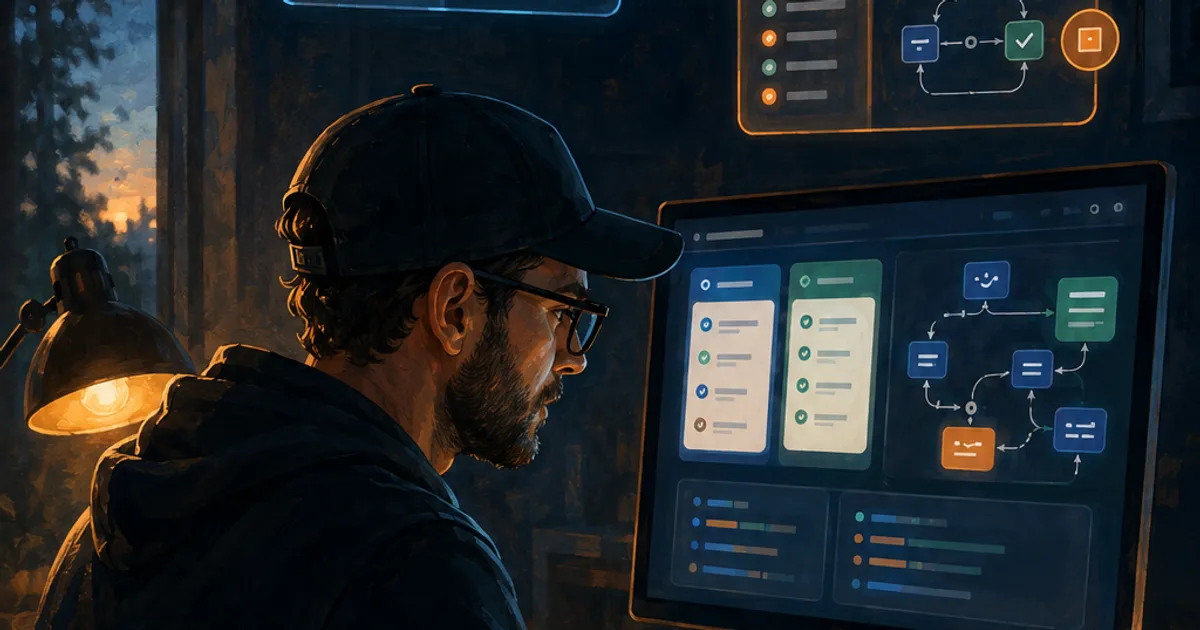
AI didn’t make me a faster typist. It made me responsible for more work at once. This was a field report, not a tooling demo: one year of AI-assisted development on enterprise Azure and React delivery, across three time zones, and what the role turned into.
The workflow got there through small experiments. Snippets first, one clear problem and one answer. Then specifications, where the agent asked questions and we agreed a plan before any code. Then parallel agents, which promptly collided over ports, data and context. Today it’s orchestration: managing context, queues, quality gates and decisions.
The first hard lesson cost four abandoned repositories. A weekend reminders app became two weeks of inconsistent UI, half-built features and repeated restarts. The tools could execute; they couldn’t hold the product vision without structure. Once guardrails, a shared specification and explicit quality gates made the loop repeatable, changing the agent mattered far less than changing the process.
What it covered
- Act 1, evolution. Snippets to specifications to parallel agents to orchestration, and the boring seven-step delivery loop that made it repeatable
- Act 2, orchestration. The main thread as team lead, a day that stopped feeling like a loop and started feeling like a queue, and attention as the scarce resource
- Act 3, systems thinking. Finishing more stories moved the constraint downstream into manual testing, so we adapted the hand-off without moving the accountability
- What human oversight actually checks, taken from a client’s AI policy: accuracy, quality, tone, bias, and generated code checked for vulnerabilities
- Why skills still matter. AI amplifies whatever you bring: system knowledge and judgment compound, and unclear intent now ships faster and more convincingly
- The AI sandwich, after Damian Maclennan: the middle got cheaper, the edges got expensive
- What I abandoned, including jumping straight to code, letting every agent solve everything, and calling it done when the tests passed
The closing line was the honest version of the whole year: AI didn’t make me 10x faster, it gave me a team, and I just didn’t realise I’d become their manager.
Matt Pocock’s work on skills helped validate and refine this approach, the boring loop included. His skills repo is in the resources below.
Resources
Comments
Join the conversation on Bluesky.